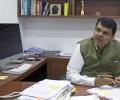
Maharashtra Chief Minister Devendra Fadnavis announced the state's ambition to become India's leader in quantum technology. The state plans to build a robust ecosystem, align with the National Quantum Mission, and train over 5,000 professionals, recognising AI, semiconductors, and quantum tech as key pillars for future growth and global competitiveness.
Deloitte India has partnered with IIT Bombay to launch a Quantum Technology Centre, aiming to accelerate quantum adoption, research, and enterprise use-cases for Indian businesses.
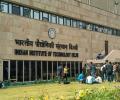
Researchers at IIT Delhi have successfully demonstrated the simultaneous transmission of quantum-entangled photons and classical data over a 50-km optical fibre link. This breakthrough addresses key challenges in integrating fragile quantum signals with existing telecommunications infrastructure, paving the way for more scalable and secure future quantum networks.
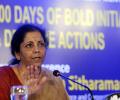
Union Finance Minister Nirmala Sitharaman has urged significant investment in AI infrastructure, semiconductors, and quantum technology, identifying them as India's next major growth frontiers. Speaking at an IIT Madras Alumni Association event, she emphasized the need to build hardware, skills, and institutional ecosystems to harness these technologies, countering perceptions that India is lagging in AI. Sitharaman also highlighted the potential for increased investment in defence production, particularly in unmanned systems and drones, stressing collaboration between academia and industry.

Andhra Pradesh Chief Minister N Chandrababu Naidu has approved the establishment of India's first dedicated Quantum and AI University campus in Amaravati by NIELIT. This significant project, funded by the MeitY, Government of India, will focus on advanced technologies like Quantum, AI, and Semiconductors, integrating education, research, and entrepreneurship.

Quantum computing is set to redefine artificial intelligence, cybersecurity, and scientific discovery, promising unprecedented speeds and capabilities while also necessitating urgent development of quantum-safe security measures and strategic enterprise readiness, says Sunil Varghese.
India's indigenous Dilution Refrigerator, developed by AQV, has successfully reached four Kelvin (-269C) at the Quantum Reference Facility in Amaravati, marking a significant milestone in the country's quantum technology development and cryogenic engineering capabilities.
West Bengal has launched an Emerging Quantum and Semiconductor Technologies (EQST) section at CSIR-CGCRI to attract investments and position the state as a hub for next-generation technology. Minister Kalyan Chakraborti highlighted India's need to invest in these crucial sectors and outlined the state's plans to collaborate with institutions and leverage budget initiatives to foster research and start-ups.

This is one of the coldest temperatures achieved in a research facility in India with more than 80 per cent domestically sourced components.

Andhra Pradesh Chief Minister N Chandrababu Naidu marked World Telecommunication and Information Society Day by emphasising the state's growing quantum technologies ecosystem and the importance of secure digital infrastructure.

Atomic Energy Commission chairman Ajit Kumar Mohanty stated that India is on the verge of a significant technological transformation, driven by advancements in AI, quantum technologies, and other fields. Speaking at BIT Mesra's convocation, he emphasised the need for strong indigenous capabilities, skilled professionals, and interdisciplinary collaboration to achieve a developed India. Other speakers, including BIT Mesra's Chancellor and Vice Chancellor, echoed the importance of continuous learning and contributing to national progress.

Patrice Caine, Chairman and CEO of Thales, highlighted Artificial Intelligence as both a major cybersecurity challenge, accelerating attack speed and autonomy, and a crucial tool for defenders. He also warned about quantum computing's future threat to encrypted data. Thales introduced new AI-powered solutions like Luna 8 and CipherTrust DSPM at its Cyber Summit 2026 to combat these evolving threats.
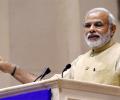
Prime Minister Narendra Modi, in his Independence Day address, highlighted technology and innovation as central to India's goal of becoming a developed nation by 2047. He called for India to lead in emerging technologies like AI, quantum computing, and space, announcing a massive AI skilling initiative for one crore youth. Modi stressed the importance of becoming a global innovation hub, bolstering energy security with nuclear power, and strengthening cybersecurity.

Andhra Pradesh is set to inaugurate India's first indigenously developed, open-access quantum computer test beds, Amaravati 1S and 1Q, at SRM University, marking a significant advancement in the nation's quantum computing capabilities.

Andhra Pradesh is set to launch India's first indigenously built, open-access quantum computers, marking a significant step towards building a sovereign quantum hardware ecosystem. The initiative aims to position the state as a global hub for quantum technology and enable applications in various sectors.
Researchers have successfully demonstrated the transmission of quantum information over commercial fibre-optic infrastructure, a significant step towards building practical quantum networks. This breakthrough addresses the challenge of cost and maintaining fragile entangled states outside laboratory settings.
Andhra Pradesh has launched India's first quantum reference facility, aiming to build a sovereign hardware ecosystem and boost indigenous manufacturing of advanced computing systems.
Andhra Pradesh and Punjab National Bank (PNB) have signed an MoU to establish the PNB Quantum Finance Hub at Amaravati Quantum Valley. This initiative aims to foster innovation and adopt next-generation technologies like AI and Quantum Computing in the banking sector, focusing on cybersecurity, fraud detection, and customer experience.
NIT Rourkela has announced the launch of four new academic programmes for the 2026-27 session, focusing on emerging technologies such as semiconductors, artificial intelligence, and quantum technologies.
Researchers have developed a new atomic clock using the element lutetium, which they claim is the most stable and accurate in the world. This clock can measure a trillionth of a second precisely and is highly resilient to environmental changes like temperature and magnetic fields, making it a significant advancement in timekeeping technology.
Researchers from IIT Bhubaneswar and Virginia Commonwealth University have theoretically predicted a new two-dimensional material, a FeCl3 monolayer, exhibiting i-wave altermagnetism. This discovery holds significant potential for developing faster, more compact, and energy-efficient electronic devices, including applications in high-density memory, spintronics, and quantum technologies.
Senior Indian officials highlight the indispensable role of the private sector in translating India-US cooperation in AI, semiconductors, quantum technologies, and critical minerals into tangible outcomes. The collaboration aims to build trusted, resilient technology ecosystems and position India as a global electronics and semiconductor hub.
BRICS leaders, in their New Delhi Declaration 2026, have called for wider access to Artificial Intelligence resources and stronger international cooperation to ensure the technology is safe, secure, inclusive, and reliable. The declaration outlines a broad technology agenda covering AI, cybersecurity, digital public infrastructure, telecom, quantum technologies, and advanced manufacturing, committing to implement the grouping's statement on 'Global Governance of Artificial Intelligence'.
The Open Quantum Institute (OQI), a joint initiative by Geneva Science and Diplomacy Anticipator (GESDA) and CERN, aims to ensure equitable access to quantum computing when it becomes widely available, fostering international cooperation and addressing societal implications.

The Karnataka government has announced the installation of a 25-qubit quantum computing system at the Indian Institute of Information Technology (IIIT), Dharwad and IIIT-Raichur, enhancing the state's quantum computing ecosystem.
SEBI Chairman Tuhin Kanta Pandey stated that cybersecurity is now a board-level concern, not just an IT challenge, emphasising the need for caution when deploying artificial intelligence in critical infrastructure. He highlighted that AI for cybersecurity must be secure, governed, and accountable, and also addressed the emerging risks from quantum computing, urging collective resilience and sharing of best practices among regulators.
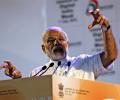
Prime Minister Narendra Modi, at the India Mobile Congress (IMC) 2026, articulated a vision for India's communications sector, emphasizing a global framework to combat cyber frauds and deepfakes. He called for India to become a hub for innovation and product development for the world. Industry leaders lauded his vision, highlighting India's robust digital infrastructure and its journey towards becoming a global technology leader, with a focus on trust, security, and responsible innovation.
The Open Quantum Institute, a joint initiative by GESDA and CERN, aims to ensure that quantum computing is accessible to all when it becomes widely available, fostering global collaboration and capacity building.

IBM India and South Asia MD Sandip Patel stated that India is at a defining moment with a unique opportunity to shape exponential technologies like artificial intelligence, emphasizing that "when India builds, it builds for billions," leading to scalable impact. Speaking at the IBM Think 2026 event, Patel highlighted that the AI revolution is still in its early stages, requiring enterprises to redesign their operations around agents, real-time data, automation, hybrid architecture, and trust. He also introduced the concept of "digital swaraj" or sovereignty in the Indian context, stressing the importance of control over operating environments, data, technology, and AI execution. IBM also announced an MoU with MeitY Startup Hub to accelerate India's deep tech innovation and startup ecosystem, providing startups access to IBM's technology expertise and platforms like watsonx and Sovereign Core.

US President Donald Trump has threatened the European Union with "very heavy tariffs" if he perceives their actions as hostile, specifically in response to Canada's efforts to deepen economic and strategic ties with the EU. This comes as European Commission President Ursula von der Leyen invited Canada to become the EU's first "associate member" to strengthen resilience amid global trade uncertainties and US trade policies.

FATF Vice-President Vivek Aggarwal has urged the fintech industry to increase investments to combat emerging threats from AI, scam compounds, virtual digital assets, and quantum computing. He warned that these technological challenges pose a significant risk to India's rapid growth in the fintech sector, highlighting a current lack of adequate investment and risk realisation within the industry.

Prime Minister Narendra Modi has urged for a global framework to combat cross-border cyber frauds and deepfakes, highlighting the need for governments, tech companies, telecom operators, and financial institutions to collaborate. Speaking at the India Mobile Congress 2026, Modi stressed that technology thrives on trust and that India is ready to share its expertise in tackling cyber threats. He also noted the rapid expansion of 5G and the success of digital governance initiatives like Direct Benefit Transfer.

Bajaj Finserv announced a strategic initiative to invest up to Rs 2,000 crore in artificial intelligence and technology-led startups over the next five years, along with a collaboration with IIT-Bombay for joint research.
Finance Minister Nirmala Sitharaman criticised commentators who express pessimism about India's demographic dividend, asserting that the country's youth are actively driving economic growth and innovation. She also highlighted the dual nature of AI and the need for robust safeguards in emerging technologies like quantum computing to balance innovation with safety.

Reserve Bank of India (RBI) Deputy Governor Rohit Jain has warned that financial institutions' increasing reliance on a small number of common technology providers, including cloud and AI model providers, could create a new source of systemic risk. He highlighted 'speed, concentration and opacity' as key risks, noting that a disruption at one provider could rapidly spread across multiple institutions, amplifying existing financial risks.

'It's A Cat And Mouse Game.'

Prime Minister Narendra Modi has introduced a 'Sapta Dhara' (seven-stream) reform framework, aiming to propel India into a developed nation by 2047. This comprehensive plan focuses on key sectors including manufacturing, agro-food processing, technology, logistics, defence, green and blue economy, and soft power, leveraging the nation's youth potential.
Finance Minister Nirmala Sitharaman has urged the Reserve Bank of India to accelerate its central bank digital currency initiatives, emphasising the need to sharpen capabilities with the digital rupee amidst rapid advancements in tokenisation, agentic AI, and quantum computing. She also highlighted critical concerns regarding cybersecurity, warning that autonomous AI systems are evolving rapidly and require robust safeguards. Sitharaman proposed a federated industry platform to give India's technology ecosystem a collective international voice.
The University of Liverpool and the Indian Institute of Science (IISc) have established a joint seed fund to promote research and innovation collaborations in areas such as AI, biomedicine, quantum technology, and space.
Researchers at Birla Institute of Technology-Mesra have developed a brain-computer interface (BCI) system that translates brain signals into real-time wheelchair navigation commands using a hybrid quantum-enhanced deep learning model.
